
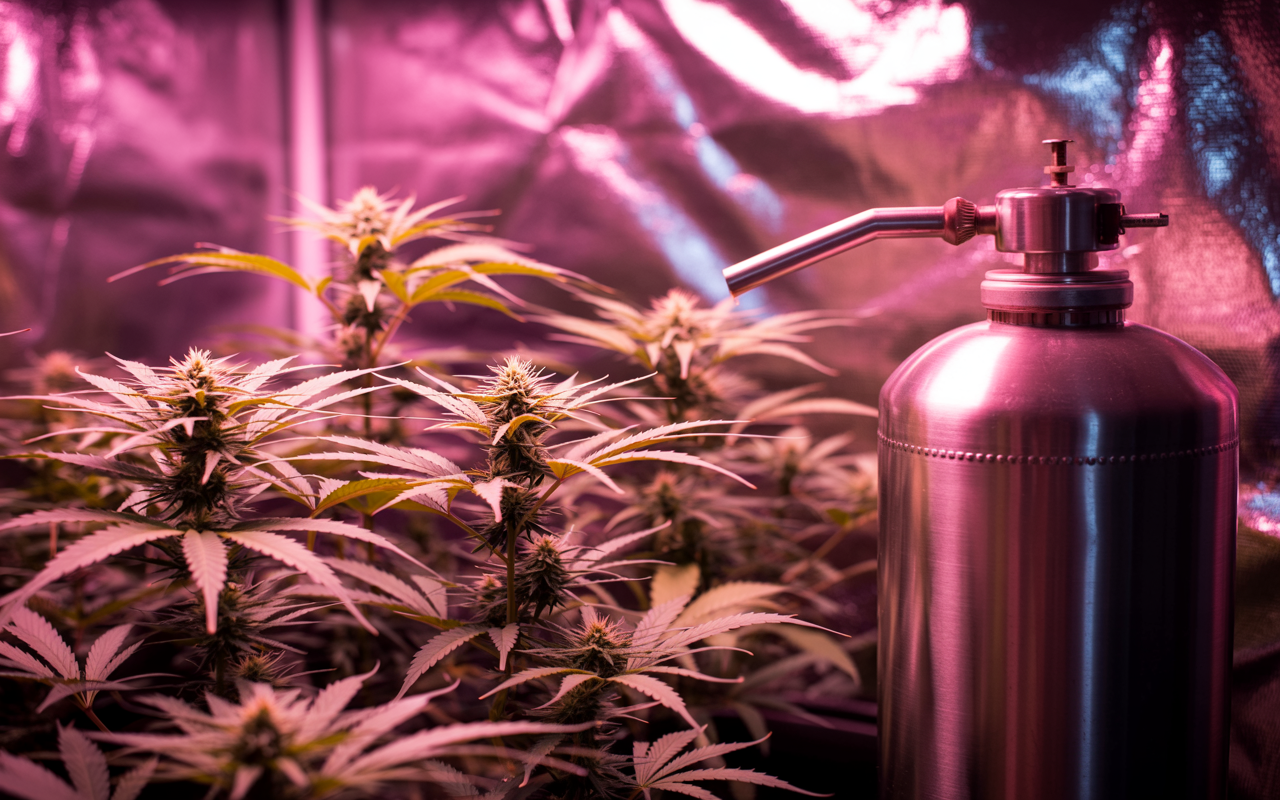
CO₂ (carbon dioxide) plays a crucial role in the photosynthesis of cannabis plants. Adding extra CO₂ to a closed growing environment can accelerate growth, improve flowering, and increase yield.
- Role of CO₂ in photosynthesis
Plants use CO₂, water and light to produce sugars and oxygen.
With sufficient light and nutrients, an increased CO₂ level can increase photosynthesis intensity, giving the plant more energy for growth and flower development.
Without sufficient CO₂, the plant cannot grow optimally, even in strong light.
2. Ideal CO₂ levels
| Growing environment | Recommended CO₂ concentration |
|---|---|
| Normal (air) | ~400 ppm (standard) |
| Improved breeding | 800–1200 ppm |
| Maximum yield | 1200–1500 ppm (only under optimal light and nutrient conditions) |
- When to add CO₂?
Vegetative stage: can promote growth rate and strong stems.
Flowering phase: Helps develop larger and denser buds, especially in bright light.
Not effective: when light or nutrients are limited; additional CO₂ only increases yield when other factors are optimal.
- Methods of CO₂ administration
CO₂ bottles or tanks
Precisely adjustable with a pressure regulator and timer.
Ideal for grow tents and small greenhouses.
CO₂ generators (gas or bio)
Fuel-powered, suitable for larger spaces.
Produces heat and CO₂ at the same time.
Cubes or tablets
Slow-release CO₂, suitable for beginners or small grow rooms.
Always ensure good ventilation and monitor CO₂ levels with a sensor to avoid overdose.
- Practical tips
Only add CO₂ when the lights are on, as photosynthesis only occurs in light.
Maintain a temperature around 25–28°C; at lower temperatures additional CO₂ becomes less effective.
Check humidity: too high RH in combination with CO₂ can promote mold.
Combine CO₂ with an optimal light intensity and nutrition plan for maximum yield.
- Safety measures
CO₂ is dangerous to humans in high concentrations; ventilation and sensors are essential.
Keep children, pets and unauthorized persons out of the growing area.
Measure CO₂ regularly to maintain levels between 800–1200 ppm for safety and efficiency.