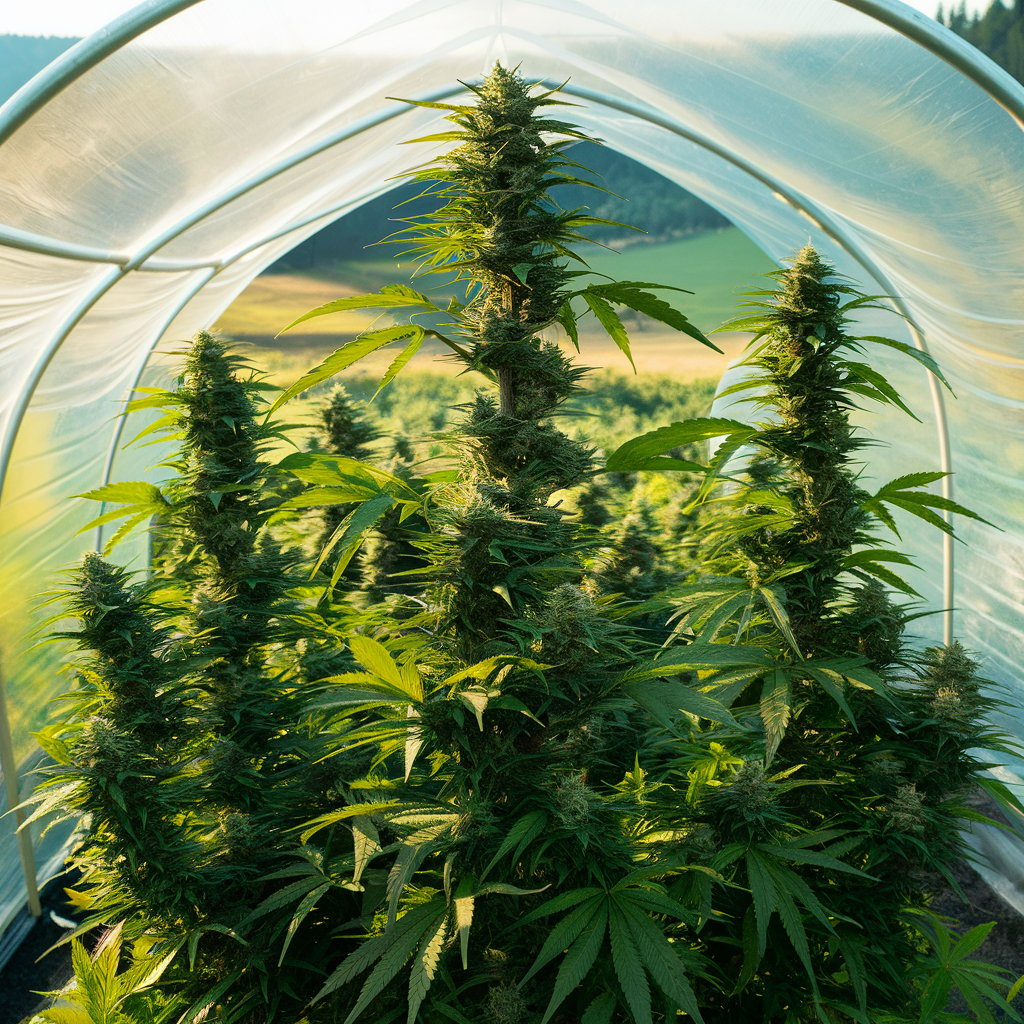
Growing cannabis in a greenhouse—or glasshouse—has become increasingly popular in recent years. This method offers an ideal balance between the natural power of outdoor cultivation and the control of indoor growing. Using a greenhouse allows the grower to benefit from sunlight while better controlling the climate, humidity, and temperature. However, this approach requires knowledge, attention, and a thorough understanding of the plant and its environment.
- Why grow cannabis in a greenhouse?
A greenhouse creates a protected space in which cannabis plants can grow under near-ideal conditions.
Advantages:
Optimal climate control
In a greenhouse, you can control the temperature and humidity quite precisely. You can ventilate on warm days and heat on cold ones. This keeps the growing environment stable.
Use of natural sunlight
Sunlight is free and ensures healthy, strong growth. Unlike indoor cultivation with lamps, greenhouse cultivation harnesses the power of nature with a smaller ecological footprint.
Protection against the elements
Rain, wind, hail, or extreme heat can damage outdoor plants. In a greenhouse, plants remain sheltered and safe, resulting in higher yields and better quality.
Longer growing season
The protection of a greenhouse allows plants to start earlier in the spring and be harvested later in the fall.
Disadvantages:
Risk of mold and pests
Due to limited air circulation, excessive humidity can cause mold growth, such as botrytis (bud rot). A good ventilation system is therefore essential.
Initial costs
Building or maintaining a greenhouse requires a significant investment. Heating, ventilation, and irrigation must be properly arranged.
Limited light cycle control
Unlike indoor cultivation, where the light schedule is completely controlled, in a greenhouse one is dependent on the natural seasons.
- Important factors for successful greenhouse cultivation
To achieve a healthy harvest, several factors must be properly coordinated.
Light and orientation
The greenhouse should ideally face south to capture as much sunlight as possible. Dirt or condensation on the glass should be removed regularly to prevent light loss.
Temperature and ventilation
Cannabis grows best between 20 and 28°C. In summer, it's important to allow warm air to escape through vents or automatic windows. In cooler periods, a small heater can help maintain a constant temperature.
Humidity
During the growth phase, humidity can be a little higher (around 60–70%), but during the flowering phase it should remain lower (40–50%) to prevent mold.
Water and food
A good irrigation system ensures that the plants never dry out, but also don't stay too wet. The pH of the water should be between 6.0 and 6.5.
Protection against pests
Regular inspection helps detect pests such as spider mites, whiteflies, or aphids early on. Biological control is an environmentally friendly option.
Species selection
Not every cannabis strain grows equally well in a greenhouse. Compact, mold-resistant varieties or autoflowering cultivars are often the best choice for beginners.
- Legislation and responsibility
Although cannabis is tolerated to a limited extent in the Netherlands, its cultivation remains officially prohibited without a permit. Even growing a few plants in a greenhouse can have legal consequences. Therefore, growers must be aware of local regulations and always act within the law.
In addition, it's important to treat the plant and its surroundings with respect and responsibility. Light pollution, odor, and energy consumption should be minimized to avoid causing a nuisance.
- Conclusion
Growing cannabis in a greenhouse combines the best of both worlds: the power of the sun and the control of a closed system. With the right preparation, knowledge, and care, a greenhouse can be a sustainable, efficient, and high-quality way to cultivate cannabis.
However, caution is still advised: the legal restrictions are clear, and successful cultivation requires time, discipline and respect for both nature and the rules.